Back to article---
title: "Operational intelligence systems, explained"
slug: "operational-intelligence-systems-explained"
date: "2026-11-10"
author: "Ben Dexter"
topics: ["Agentic AI", "Digital Transformation"]
summary: "A plain-English guide to operational intelligence systems, how they work on Claude Team, Qui and Microsoft AI Cloud, and which suit highly secure environments."
description: "A plain-English guide to operational intelligence systems, how they work on Claude Team, Qui and Microsoft AI Cloud (Copilot), and which suit highly secure environments."
keywords: "operational intelligence system, operational intelligence platform, Claude Team, Qui, Microsoft Copilot, Copilot Studio, sovereign AI Australia, in-country data processing, AI governance"
aeo_summary: "An operational intelligence system connects a business's systems, data and knowledge so AI agents can understand context, act within approved limits and show their work. Claude Team is the fastest to start but processes data offshore. Microsoft AI Cloud (Copilot) and Qui offer quasi-sovereign options, through in-country processing and private or local model deployment, making them the better fit for highly secure environments."
cta: "Not sure which platform fits your risk profile? Start with a 30-minute conversation and we'll map it to your data, people and processes."
---
**An operational intelligence system is the layer that lets AI work across your business rather than inside a single app. It connects your systems, data and knowledge, gives AI agents the context to act, and keeps people in charge of the decisions that matter. The platform you build it on matters most when your data is sensitive.**
Most organisations already have AI. Someone uses a chat assistant, a team trials Copilot, a vendor adds an "AI feature". What they rarely have is coordination. Each tool sees a sliver of the business, and staff are still the glue that moves information between systems.
In fact, the piecemeal and siloed approach of individual team members using AI (much of it shadow AI usage on individual ChatGPT and Claude accounts rather than on a single platform) is often why businesses complain of a lack of value from AI.
An operational intelligence system changes that. It is the 'big picture' of AI-led transformation as it aims to draw from your systems of record, delivering intelligence, coordinating tasks across teams, and manoeuvring staff users ***from*** pseudo data generators and integrators ***to*** intelligence and task coordinators.
So while we initially work with clients to establish a (re)Engineering for Growth™ mindset – commencing with a single Agentic AI process aiming to deliver quantitative and/or qualitative value (e.g. efficiency, profitability, quality, satisfaction) – we also set our minds to a longer term vision of incrementally building a centralised operational intelligence system.
## How an operational intelligence system works
Strip away the branding and every operational intelligence system does four things.
1. **Connect.** It reaches into the places work actually lives: email, documents, CRM, finance, job management and line-of-business systems.
2. **Understand.** It holds context: shared knowledge, memory of past work, and the rules of how your business operates.
3. **Act.** AI agents carry out defined tasks, such as triaging requests, drafting reports or reconciling data, and pause for human approval where it counts.
4. **Govern and measure.** Identity, permissions and audit trails control who and what can do each thing, and results are measured against business value.
The technology is the easy part. The value comes from reengineering the process first, so people move from re-keying data to overseeing and deciding.
As a side note, the diagram below illustrates where an Operational Intelligence layer may sit in your technology landscape. Allow me for a moment to paint a picture as to where the future value of your IT systems, IP and data sit. In the past, businesses invested heavily in applications such as HubSpot, Dynamics 365 CRM and Salesforce. So much of the value of these systems sat in the app or interface layer with sometimes millions of lines of code displaying and processing data to users. Now each of these vendors realises that the value is no longer in this layer (you have heard the adage "SaaS is dead").
Instead the 'value' has now shifted: while data and file stores remain the core of a business's value, the traditional application layer (the front end interface that everyone has been staring at for decades) is gradually becoming redundant as users gravitate towards AI agents that gather, process, present and distribute data.
We have done this at X.D. We rarely touch HubSpot, underlying Microsoft services, or financial/client systems of record. Much of the coordination is performed agentically (while adhering to client agreements and Australian Government AI guidance).
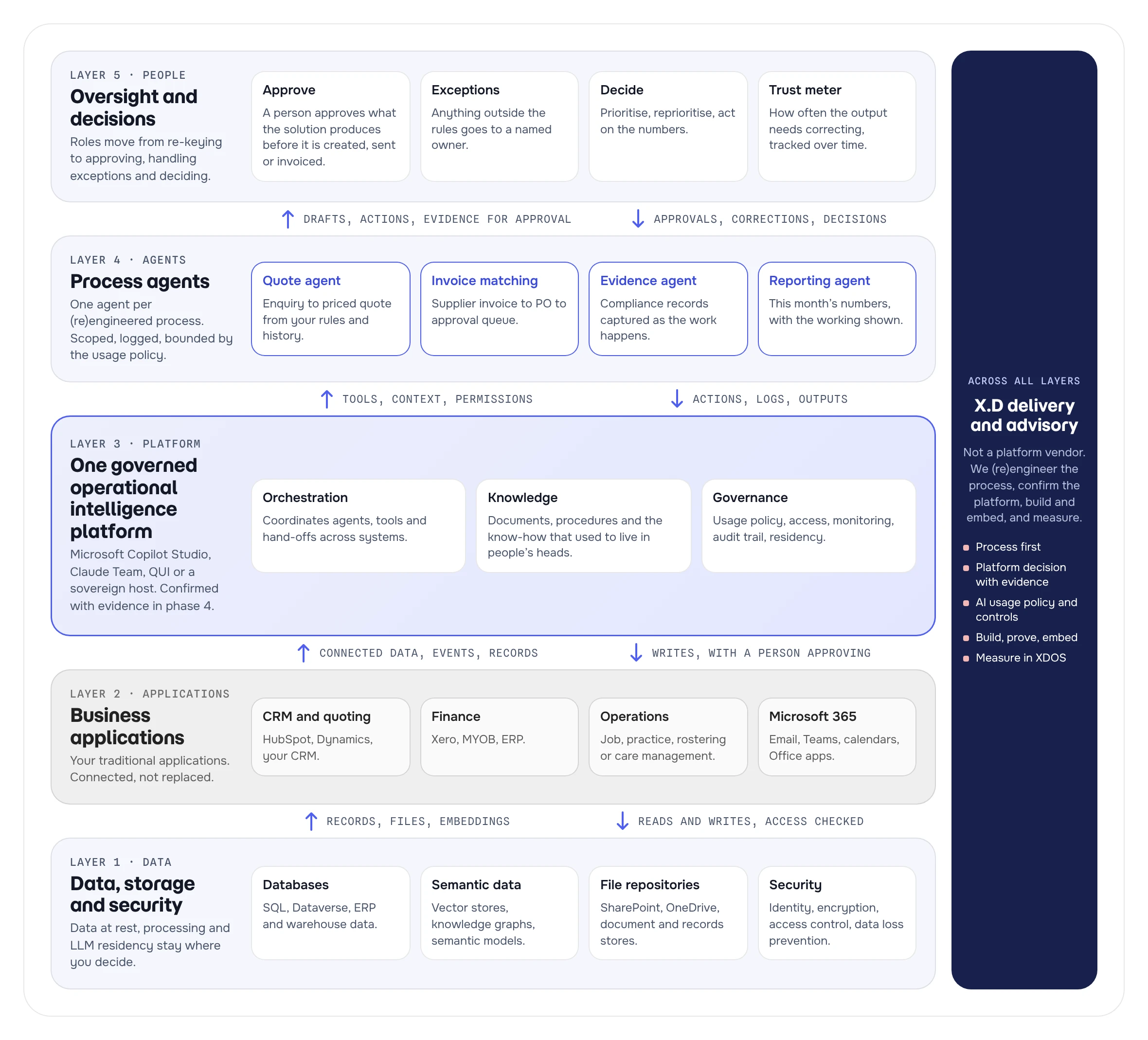
*The X.D operational intelligence model. Illustrative: the agents shown are examples, chosen in practice from the processes you select.*
## Three ways to build one
So, in simple terms, how is operational intelligence built? The first important point to establish is that businesses must establish a clear strategy before leaping. Secondly, and maybe unlike many large digital transformation (e.g. CRM or ERP) projects I've been involved in over the years, businesses can incrementally build towards operational intelligence by carefully optimising processes one by one or a few at a time. Ultimately, the approach should be tailored for your unique business circumstances and considerate of the enterprise's governance, risk and compliance environment; resource capacity/capability; customer expectations; and corporate values/ethics.
Below, I paint a very high-level, platform-centric view of what tools may be used to build an operational intelligence system.
### Claude Team
I mention Anthropic's Claude here, but one may interchange Claude with any multi-modal agentic AI app such as ChatGPT or Mistral (Le Chat Team or Enterprise). But, for now, let's go with Claude as it is the most integration-ready of all AI platforms as of November 2026.
Claude Team is the quickest route to capable AI across a team. Connectors link Claude to tools such as Microsoft 365, Google Workspace and Slack, and Projects give teams shared knowledge to work from. Administrators decide which connectors staff can use, and business data isn't used to train models.
The trade-off is location and control. Claude for Work runs as a hosted service, with processing on US infrastructure (as of November 2026), and stronger identity and audit controls sit in the Enterprise plan. It is excellent for knowledge work and prototyping, but it isn't a sovereign\* option.
Strategy, Marketing and Sales teams are well-positioned to use Claude as it is the most capable all-rounder for producing high quality branded and strategic outputs. However, due to the data sovereignty / IP and security concerns, we would typically recommend alternative, more regulated AI solutions for the rest of the business.
### Qui
[Qui](https://qui.is/) describes itself as company-controlled AI infrastructure for persistent, governed agents. Agents keep memory, use tools, route between models and stop for human approval, and the platform records evidence of the work they do. It's a fascinating platform that is ideal for highly process-driven organisations.
Its strength for secure environments is deployment choice. Qui offers managed cloud, a private cloud option and locally run models, and it isn't tied to one model vendor. That means prompts, agent memory and data can stay on infrastructure you control. Qui's sovereignty comes from where you run it and who controls it rather than from Australian ownership. But it offers an 'independent' solution and the flexibility to operate with many AI LLM vendors. *When* the AI bubble bursts, *this* will matter!
At X.D, we put forward this solution for non-Microsoft-aligned businesses or those that prefer to spread risk across multiple vendors or those that want complete control over *how data is processed* and *intelligence is delivered*.
If you're looking to finally replace the 459 spreadsheets that run your organisation today, Qui is an excellent option.
### Microsoft AI Cloud (Copilot)
For organisations already on Microsoft 365, Copilot and [Copilot Studio](https://www.microsoft.com/en-au/copilot/products/copilot-studio) build operational intelligence on top of the data, identity and security tools they already run. Microsoft Entra ID controls access, Purview applies data protection, and agents built in Copilot Studio work inside the same tenant.
Microsoft has committed to in-country processing of Microsoft 365 Copilot interactions for Australian customers, meaning prompts and responses are processed in Australian data centres under normal operations. The exception is Anthropic's Claude models inside Copilot: they are switched on by default for Australian tenants and sit outside Microsoft's in-country processing commitments, so admins with strict residency needs should turn them off in the Microsoft 365 admin centre. For stricter needs, its Sovereign Private Cloud and Azure Local support dedicated and even disconnected environments. As with Qui, the provider is US-headquartered, so this is strong control rather than full sovereignty.
While Microsoft's solutions are incredibly robust and represent the gold standard in AI governance, expect an additional 25–30% setup and maintenance effort overhead. If done well, any additional costs should be easily absorbed by the value derived from your AI initiatives.
*\* A quick note on sovereignty: As at the time of publication, there are no pure Australian AI large language model vendors. However, there are vendors that offer local data storage and processing solutions. Amazon Bedrock provides Australian-based (Sydney and Melbourne) data processing and storage leveraging Anthropic Claude services, as does Qui. Microsoft's AI Cloud processes Copilot interactions in Australia, but not when Copilot uses Anthropic's Claude models. We like to call these solutions 'quasi-sovereign'.*
## Comparison: which suits a highly secure environment?
"Quasi-sovereign" here means your data and AI processing can stay in Australia or on infrastructure you control, even though the platform vendor is based overseas.
| | Claude Team | Qui | Microsoft AI Cloud (Copilot) |
|---|---|---|---|
| **Best at** | Fast, high-quality reasoning for knowledge work | Persistent, governed agents with model choice | Agents inside the Microsoft 365 tenant you already run |
| **Where AI processing happens** | Hosted service, US infrastructure | Managed cloud, private cloud or local | In-country processing in Australia for Copilot (Anthropic models excluded); private and disconnected options on Azure Local |
| **Locally hosted models** | No | Yes | Yes, through Azure Local and private cloud options |
| **Model choice** | Claude models | Model-neutral routing | Microsoft-selected models, wider choice in Azure |
| **Identity and access** | Admin controls; SSO and audit logs on Enterprise | Tool permissions, tenancy and human review | Entra ID, Purview and existing Microsoft security |
| **Quasi-sovereign option** | No | Yes, by deploying privately or locally | Yes, through in-country processing and Sovereign Private Cloud |
| **Fit for highly secure environments** | Low | **High** | **High** |
## Which one should you choose?
For highly secure environments, such as health, aged care, critical infrastructure and organisations handling sensitive client data, **Microsoft and Qui are the stronger choices.**
- **Choose Microsoft** if you already run Microsoft 365 and want operational intelligence inside the identity, security and compliance controls you have today.
- **Choose Qui** if you want agents that run on infrastructure you control, with the freedom to change models as they improve.
- **Use Claude Team** where speed and reasoning quality matter more than data location, such as drafting, research and prototyping with lower-sensitivity information.
Importantly, many organisations will use more than one. What matters is deciding which work runs where, based on the sensitivity of the data and the risk of the decision, rather than on which tool arrived first.
For instance, Claude Team or Enterprise is perfect for Marketing and Sales teams that need to rapidly produce branded materials, marketing communications and tender response documents. However, where data processing, automation, compliance or governance are concerns (i.e. Operations, Finance, etc.), we would typically recommend Microsoft or Qui as these platforms offer more control over all dimensions of your intelligence layer.
## The takeaway
An operational intelligence system isn't necessarily a product you buy. It's a way of connecting your business so AI can do useful, governed work. Start with the process and the data, then choose the platform that matches your risk profile. Don't start with the tools. But best of all, because it operates as an intelligence layer, businesses don't need to necessarily perform wholesale software changes to accommodate operational intelligence. A well-designed operational intelligence system operates as a layer connecting users to data stores.
## Sources and further reading
- [Microsoft offers in-country data processing to 15 countries to strengthen sovereign controls for Microsoft 365 Copilot](https://www.microsoft.com/en-us/microsoft-365/blog/?p=279984) (Microsoft)
- [Microsoft strengthens sovereign cloud capabilities with new services](https://azure.microsoft.com/en-us/blog/?p=47677) (Microsoft Azure)
- [Anthropic models in Microsoft Online Services](https://learn.microsoft.com/en-us/microsoft-365/copilot/connect-to-ai-subprocessor) (Microsoft Learn)
- [Amazon Bedrock cross-Region inference for Claude in Australia](https://aws.amazon.com/blogs/machine-learning/introducing-amazon-bedrock-cross-region-inference-for-claude-sonnet-4-5-and-haiku-4-5-in-japan-and-australia/) (AWS)
- [Qui: company-controlled AI infrastructure](https://qui.is/) (Qui Intelligent Systems)
- [Claude for Work (Team and Enterprise) FAQs](https://support.claude.com/fr/collections/10351016) (Anthropic)